 | en April 2021    |
|
|
| |||
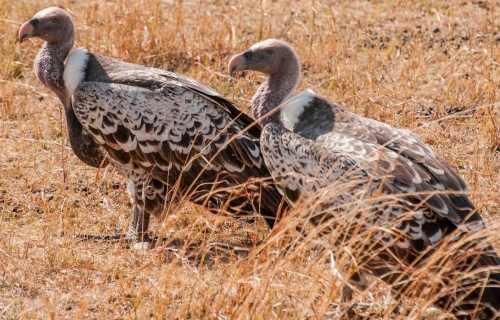
Currently, global climate change is transforming natural habitats in many parts of the world, which will cause important changes in the medium and long term in the distribution, migration and phenology of many species of birds. Scientific evidence supports the fact that in the northern hemisphere a displacement of the distribution areas of southern species towards the north is taking place; this will imply new challenges in the conservation of some populations already threatened by other causes. An example of a species that seems to be already showing changes in its distribution is the Rüppell's vulture (Gyps rueppelli), listed as ‘Critically Endangered’ at the global level in the IUCN Red List of Threatened Species™, the last category before global extinction. This African scavenger is widely distributed in the equatorial and eastern open areas of the continent. While it is increasingly rare in its historic breeding areas, in recent times it has become a regular visitor to the Mediterranean region, which could be revealing an expansion of its distribution range. The species was considered casual or vagrant in North Africa and Spain. But in the last 15 years, the species has been recorded far away from its breeding colonies, reaching the Iberian Peninsula through Morocco and the Strait of Gibraltar together with migrating Gyps fulvus (Botha et al., 2017), even breeding in Algeria today (Garrido et al., In press). Recently some individuals of Rüppell´s vulture have been observed as showing breeding behaviour in griffon vulture (Gyps fulvus) colonies in Andalusia, southern Spain (Elorriaga et al., 2020), where the species was recently added to the list of resident species (CAGPDS, 2019), making it Europe's 5th vulture species. Immatures also migrate together with griffon vultures through Morocco and Algeria (Botha et al., 2017). The potential expansion of the species in the northern Sahel may well represent the beginning of a colonisation process towards habitats that are more suitable and a response to climate change and other important mortality factors in its original breeding areas, such as habitat degradation and poisoning (Onrubia et al, 2020). If this were the case, the implications of the process are of great relevance since the Mediterranean basin could become a refuge, and southern Spain and the Maghreb, relevant areas for the global conservation of this threatened species. Knowing how climate change is affecting the distribution of threatened species and what the possible future scenarios are is essential to ensure effective conservation measures both in the short and long term. The First international symposium on the Rüppell’s vulture in the Mediterranean region (24th March 2021, online), organised by the IUCN Centre for Mediterranean Cooperation, with the support of the MAVA Foundation and the Autonomous Government of Andalusia (Junta de Andalucía), brought together leading international experts and authorities involved in species conservation. The main objectives of the event were to compile and unify existing information on the status of the species in the Mediterranean region; to assess the role that the region could play for the conservation of this vulture; to establish common management and conservation lines and to create links among relevant African and International institutions. Presentations The Global Status of the Rüppell’s vulture (Gyps rueppelli). André Botha (Endangered Wildlife Trust, CMS Vulture MsAP & IUCN Species Survival Commission - Vulture Specialist Group) Rüppell’s vulture is mainly distributed in the Sahel. The species has suffered a very significant population and geographical decline since 1992, subject to extremely rapid population declines, about 97 % over the last 30 years (Ogada et al, 2016), especially in West Africa, mainly due to poisoning, persecution and electrocution and collision with power lines. Other important threats, such as habitat reduction, disturbance at nesting sites and reduced food availability are hard to know and quantify. Thus, Rüppell's vultures are becoming alarmingly scarce in southern Africa but they are increasingly seen outside their distribution range, to the south (South Africa, Mozambique or Malawi), and to the north (Spain or Israel). The status of the Rüppell’s vulture in southern Europe (The fifth vulture species for Andalusia and Europe). Iñigo Fajardo (Vulture Conservation Programme & Head of the Anti-poison Programme -Junta de Andalucía, Spain) The species has been increasingly recorded in Andalusia since 1990, and has become a regular visitor travelling with the griffon vultures returning to Spain from Sahel wintering areas. To date, there have been more than 1668 records, mainly in Andalusia, where adult and young birds are present throughout the region and throughout the year. Furthermore, there have been several breeding attempts, two of them with griffon vultures. The species has been recently included in the Andalusian Vulture Conservation Programme, as any other native species (August 2019). The conservation status of Rüppell's vulture in North Africa. José Rafael Garrido (Junta de Andalucía, Spain & IUCN Species Survival Commission – Bird Specialist Group) Until recently, the species was considered casual or a vagrant in North Africa, but nowadays this has changed. Regular non-breeding populations in Morocco, mainly near the Strait of Gibraltar, and breeding observations within griffon vulture colonies in Algeria since 2006, have been recorded. Immatures also migrate with griffon vultures through Morocco and Algeria. Given that the expansion to Algeria could be the beginning of a colonisation process caused by global climate change, habitat degradation and other threats in breeding areas south of the Sahel, the species is listed as Critically Endangered under criterion D in the North Africa breeding raptors Red List. Further research should be conducted to ascertain the real breeding numbers, the population trend and the importance of North African population to the global conservation of the species. Rüppell’s vulture in the Sahel. Violeta Barrios (Sahara Conservation Fund) Rüppell’s vulture is the most abundant breeding vulture in the Sahel, breeding in protected and non-protected areas. They usually nest on cliffs but in the Sahel they have been observed nesting in trees in countries like Niger and Chad, interacting with the Lappet-faced vulture. This behaviour makes the individuals more vulnerable to human disturbances. The main threats are drought, nest destruction, poaching for belief-based use and illegal trade (mainly to Nigeria) and changes in livestock management, as they are very dependent on this type of carcass. Other threats like poisoning or electrocution remain unknown. The main knowledge gaps are linked to their tree nesting behaviour, their interaction with Lappet-faced vultures and their seasonal movements. The phrenological status and scientific monitoring of the Rüppell’s vulture in Morocco. Rachid El Khamlichi (GREPOM/BirdLife Maroc) & Karim Rousselon (Association Marocaine pour la Protection des Rapaces -AMPR- & International Association for Falconry -IAF-) The Rüppell's vulture was first observed in Morocco in June 2002 in the southern shore of the Strait of Gibraltar. The observations have been increasing since then, from 1 individual in 2002 to 55 in 2020, due to the increasing number of migrant European griffon vultures returning from sub-Saharan Africa in spring. A scientific monitoring programme for the species was launched in June 2020 by the Department of Water and Forests and GREPOM/BirdLife, in collaboration with AMPR and the Emirates Center For Wildlife Propagation (ECWP). This programme has allowed the capture and tagging with wing tags of 26 immatures, 12 were equipped with GPS and Argos/satellite beacons. Monitoring of these individuals has shown routes to sub-Saharan Africa through Morocco, Mauritania, southwest Algeria, Mali, Senegal, Gambia and Burkina Faso. Several died and almost all stopped transmitting after a few months. Latest data from Rüppell’s vulture in Algeria. Amina Fellous-Djardini (Mouvement Écologique Algérien) & Lahouari Djardini (Direction Générale des Forêts, Algeria) The species was first observed in Algeria in 2006, with at least two possible breeding pairs in griffon vulture breeding colonies in the Aures region. Wandering of immature birds has been observed in Sahelian area, which suggests a possible follow up of migration flights mixed with griffon vultures to new sites. There has been one recent observation of an adult bird in central Sahara. More studies and surveys of the species in Algeria are needed. On the other hand, hybridisation with griffon vultures has been observed both in captivity and in the wild. Current status and information for 2004-2016 and 2020 of Rüppell's vulture in Algeria. Haféda Benmammar Hasnaoui (Parc national de Tlemcen, Communication, Education and Public Awareness focal point at AEWA & Communication Commission for the national network of Algerian ornithologists) Of the 5 species of vultures mentioned in the literature in Algeria, the Ruppell's vulture has never been mentioned in the bibliography until 2004 and 2006 when it was recorded (and captured) in Tlemcen National Park. In 2020, one adult was captured in the Adrar region, south-west of the country. The bird is currently kept in captivity, under the supervision of the territorial services of the General Directorate of Forests and Wildlife Protection, with a view to its future release. Is the griffon vulture the proxy for the presence in North Africa and Europe? Movements through the Strait of Gibraltar. Alejandro Onrubia (Migres Foundation) Colonisation process of Rüppell’s vulture in North Africa and Europe is linked to the increase of Griffon vulture populations in Western Europe and of individuals migrating to Africa, and to the decrease of Rüppell’s vulture populations in Africa. The return of griffon vultures to Europe occurs at the end of the dry season, when Rüppell’s vulture juveniles fledge and start to disperse. Both species fly northwards in mixed flocks, probably due to the increasing frequency of droughts in the Sahel. Threats and current conservation actions on vultures in the Mediterranean Region. José Tavares (Vulture Conservation Foundation) The main threats to vultures in Europe are unintentional poisoning, electrocution on energy infrastructure and decline of food availability. Other secondary threats are collision with energy infrastructure, unintentional intoxication with NSAIDs and lead and direct persecution by shooting. To minimise these threats European institutions and NGOs have developed national anti-poisoning working groups and strategies, programmes to reduce mortality on power lines and wind farms and securing scavenger-feeding zones. Thanks to these measures, vulture populations in Europe are increasing. Is the Mediterranean region key for the global conservation of the Rüppell’s vulture? José Rafael Garrido (Junta de Andalucía, Spain & IUCN Species Survival Commission – Bird Specialist Group) It is unclear whether the Rüppell’s vultures are colonising the Mediterranean region or whether there is displacement of breeding populations from the Sahel towards the Mediterranean region due to its critical status in the Sahel. A key question to be determined is whether they are sustainable populations or isolated individuals destined to disappear due to genetic interbreeding with griffon vultures. The species has been listed as Critically Endangered in North Africa and included in the Vulture Conservation Programme of Andalusia, but it must be monitored to ascertain the real importance of the Mediterranean population for the global conservation of the species and the origin of the vultures in Iberia and North Africa. It is necessary to elaborate an Action Plan to promote the establishment of the species in Andalusia, Morocco and Algeria. Discussions arising The global situation of the species and the population trends that are being observed in the Mediterranean basin prompt us to assess whether this region could become a key area for the conservation of the Rüppell's vulture in the near future. In order to answer this question it is essential to improve knowledge about its actual distribution and population trends in North Africa. In order to better understand this colonisation process and the link between the specimens that reach the Mediterranean and the known Sahelian colonies, especially those from Chad, Mali and Niger, it is especially important to confirm the existence of breeding colonies in Algeria and to strength the existing monitoring and tracking initiatives. The importance of better understanding the relationship between this species and the griffon vulture was also mentioned because it seems to be a factor responsible for the colonisation process we are witnessing. The relationship should be studied not only in terms of behaviour in the areas where the two species coincide, but also in terms of the possible hybridisation processes that may occur (or have already occurred). To do so, it is necessary to develop and implement protocols and techniques for the detection and identification of hybrid individuals. Likewise, it is necessary to improve knowledge about the threats that affect the species, both north and south of the Sahara, especially in the south, where illegal capture and trade for belief-based practices may be causing a significant impact, which has not been evaluated to date. Improved knowledge should provide the keys to carry out coordinated action that ensure the future of the species. From the data available in Andalusia on the mortality of the species, it could be suggested that Rüppell's vulture mortality rate may be higher than griffons’, possibly because of exhaustion due to migration. Thanks to the monitoring programme in Morocco, we know that some vultures have attempted to cross the Strait of Gibraltar without success, which supports the hypothesis of Moroccan experts that the species shows a reluctance to cross the sea and that the attempts could be a highly energy-consuming activity. One of the key points that emerged from the discussion was the need for information exchange among different organisations involved in the study, management and conservation of the species. The availability and exchange of information on the species biology, ecology, distribution and mortality, as well as good practices, existing gaps or management actions will be fundamental to ensure successful conservation actions. Conclusions The main highlights of the interventions during the symposium were: -There is a decrease in the occurrences from the original range but increased occurrences in northern Africa and southern Spain. -The movements towards the North seem to be linked to the disturbance of the species in the southern Sahel and to the griffon vulture movements. -The real causes of these changes remain unknown. -There are possible breeding cases between Rüppell’s vulture and griffon vulture in Spain and North Africa, but very little is known about hybridisation. -Occurrences in Morocco and Spain seem to be linked to the populations from West Africa; occurrences in Algeria seem to be linked to the populations from Central Africa. Increasing research and monitoring programme efforts is needed. -The colonisation process needs to be confirmed and understood in order to design effective conservation measures. Rüppell's vulture is a species to be taken into account from now on in the Mediterranean according to the data provided during this symposium by the different experts. The path that management policies will take in the concerned countries, will guide the future of the species in the region. It is crucial that these policies are supported by scientific data. Data which are currently scarce, with many gaps and more questions than answers. As it has been pointed out throughout the interventions, efforts must be made to fill in these gaps, but this should not be an impediment to taking action now. The critical status of the species so requires. Cooperation among different countries and concerned institutions is essential since any action at the local level will have a reduced effect if the species continues to decrease in numbers at its original range and its migration and wintering areas. The national authorities in the Mediterranean region where the species is present, as well as the different NGOs working in the region, are willing to make joint efforts through increased cooperation between both sides of the Mediterranean and between North Africa and the Sahel countries. Countries and organisations with more resources and experience would act as drivers of such cooperation, providing resources and sharing knowledge, and seeking possible sources of funding within the framework of existing sources for wildlife conservation. The critical situation of the species in southern Sahel requires urgent and coordinated measures. The importance and suitability of holding this symposium has been highlighted by the speakers and participants and this is undoubtedly demonstrated by the interesting discussions and exchanges that aroused during and after the event. It is a first but important step towards increasing and sharing Rüppell's vulture knowledge. A first step to define the future of the species in the Mediterranean and to assess the role that the region is currently playing and can potentially play for the conservation of the species.
|
|
| Subscribe to our bulletin | To unsubscribe from our bulletin Receive the lastest IUCN World Conservation Congress updates, subscribe here. Copyright® 1995-2020 International Union for Conservation of Nature and Natural Resources. All rights reserved. |