 | en - es January 2021    |
|
|
| |||
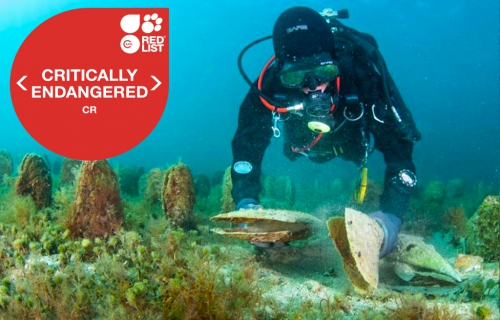
An online meeting facilitated by IUCN-Med presented the progress of the mortality and monitoring results from different Mediterranean institutions working to recover the Critically Endangered (CR) populations of Pinna Nobilis, now included on the IUCN Red List of Threatened Species. This meeting also outlined potential pathways for coordinating a joint response to the mass mortality event across the Mediterranean. 33 researchers and representatives from the public administrations in 13 countries took part in this meeting.
Since 2016, a mortality outbreak has led to the decline of the Noble Pen Shell (Pinna nobilis) population. The disease originally attributed to a haplosporidian parasite has continued to expand rapidly throughout the Mediterranean. Building on the information shared by a wide range of Mediterranean partners, the Pinna nobilis was classified in the IUCN Red List of Threatened Species as Critically Endangered. Only a few populations are known to remain pathogen-free. However, these are geographically isolated and located in sites with very specific environmental conditions. The purpose of online meeting facilitated by IUCN-Med was to present the current status of Pinna nobilis populations across all Mediterranean countries, as well as sharing knowledge on the different infectious diseases affecting the populations, alongside with conservation measures and rescue attempts, learnings from these initiatives, experiences maintaining individuals in culture facilities, the role of unaffected populations and in-door juveniles for potential recovery. During the first session, both governmental and non-governmental institutions presented the results of their monitoring efforts, including mortality and survival estimates, distribution, conservation measures underway and rescue attempts in different zones. The second session, moderated by Institut Océanographique de Monaco focused on the conservation of Pinna nobilis in captivity conditions, such as aquariums, and research in the field of aquaculture. The closing session highlighted the role of unaffected populations for a potential recovery, established with a network of larval collector stations to enhance larval dispersal from unaffected sites and potential recolonization through recruitment of resistant juveniles. Cooperation with national ministries can be key for fast action A report of this meeting will be available on the web in late January. For further information or if you would like to contribute to this initiative, please contact María del Mar Otero. |
|
| Subscribe to our bulletin | To unsubscribe from our bulletin Receive the lastest IUCN World Conservation Congress updates, subscribe here. Copyright® 1995-2020 International Union for Conservation of Nature and Natural Resources. All rights reserved. |