 | en - es - fr August 2020    |
|
|
| |||
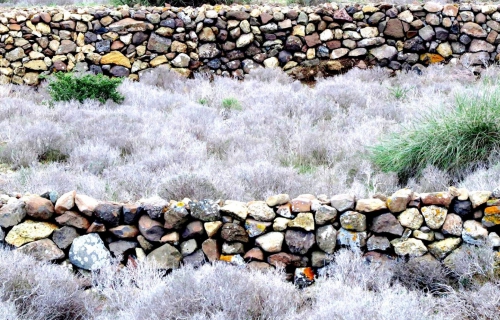
Steeply sloped areas where the vegetation cover is especially thin are highly vulnerable to erosion. This is the case of the National Park of Cabo de Gata Nijar in Almeria (South of Spain), where land impoverishment is causing a loss of traditional low-impact agriculture, as agricultural intensification expands. By restoring dry-stone walls known as ‘balates – an ancestral system introduced by the Moorish, the LIFE Adaptamed project is working to halt loss of soil, while increasing water retention and conserving the local biodiversity. From the Pontic mountains in Turkey to the Atlas Mountains in Morocco, agricultural terraces are a typical “cultural landscape” in the Mediterranean, which shows how human activity can help mountain ecosystems become more resilient. Dry stone walling knowledge and techniques are in fact recognised by UNESCO as a part of the world’s Intangible Cultural Heritage of Humanity. The goal of rebuilding the ‘balates’ dry-stone walls is to contribute to the sustainability of agriculture in this site, while protecting the soil, increasing its capacity to sequester carbon dioxide and regulating the water cycles. In the last years, the team of LIFE Adaptamed has managed to restore up to 1,000 linear meters of these dry stone walls. “In this site, ‘balates’ dry-stone walls have been used in traditional rainfed cereal crops, which nowadays serve as a refuge to a rich biodiversity, including steppe birds, reptiles and invertebrates” – explains José Miguel Barea, technical coordinator of the project. LIFE Adaptamed is a project that works to adapt and protect the ecosystem services of 3 of the main protected areas in the southern peninsula (Doñana, Sierra Nevada and Cabo de Gata), in the context of climate change and global environmental change. Through adaptive management measures, which involve the management of habitats to increase their resistance and resilience, the aim is to improve the capacity to provide goods and services. Under the leadership of the Ministry of Environment of Andalucia (Agency for Environment and Water – Amaya), LIFE Adaptamed is a project supported by the International Union for Conservation of Nature (Mediterranean Cooperation Centre), the universities of Granada and Almeria and the Superior Council for Scientific Research (CSIC, Doñana Biological Station). “Balates” are small walls built with stones on steep or sloping terrain, which make it possible to create an agricultural terrace. Faced with the difficulty of cultivating and carrying out conventional agriculture on rocky terrain of great unevenness, the balates allow to gain soil by creating a fertile space that benefits from rainfall and retains surface waters. This system can be found in other parts of southern Spain, such as the Sierra Nevada National Park, where it has been used by farmers to protect the thin vegetation cover for centuries. In the Mediterranean, strong torrential rains pose a high risk of erosion and landslides caused by floods and runoff. In this context, the ‘balates’ drainage system increases water infiltration, making it possible to store the water that can be used for natural irrigation. Images: Revista el Observador. Rafael Yus Ramos Sources Plan de Desarrollo Sostenible del Parque Natural Cabo de Gata-Níjar Los balates: ¿un patrimonio de la humanidad en extinción? Revista el Observador. Rafael Yus Ramos http://www.revistaelobservador.com/images/stories/envios_18/noviembre/balates1.pdf Conocimientos y técnicas del arte de construir muros en piedra seca, UNESCO
The Mountains of the Mediterranean World, J. R. McNeill |
|
| Subscribe to our bulletin | To unsubscribe from our bulletin Receive the lastest IUCN World Conservation Congress updates, subscribe here. Copyright® 1995-2020 International Union for Conservation of Nature and Natural Resources. All rights reserved. |